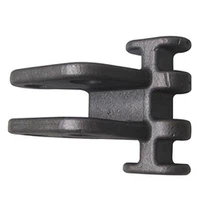
OEM Custom Ductile Iron Shell Mould Casting Component from China foundry with Engineering and CNC Machining Services
Shell molding casting is also called pre-coated resin sand casting, hot shell molding casting or core casting. The main molding material is the pre-coated phenolic resin sand, which is more expensive than green sand and furan resin sand. Moreover, this sand can not be recycle used. Therefore, the shell molding castings have higher costs than sand casting. However, compared to the green sand casting, the shell molding castings have many advantages such as higher dimensional tolerance, good surface quality and less casting defects. The shell molding casting process is specially suitable for producing castings of difficult shapes, pressure vessels, weight sensitive and castings requiring superior surface finishes.
The shell molding casting components have a little higher costs than sand casting. However, the shell molding casting parts have many advantages such as tighter dimensional tolerance, good surface quality and less casting defects.
Ductile cast iron, which is represent a group of cast iron, also called nodular iron. Nodular cast iron obtains nodular graphite through spheroidization and inoculation treatment, which effectively improves the mechanical properties of the cast iron, especially the plasticity and toughness, so as to obtain higher strength than carbon steel. Ductile iron castings have better shock absorption performance than carbon steel, while carbon steel castings have much better weldability. And to some extent, the ductile iorn castings could have some performances of resistanting wear and rust. So the ductile iron casting could be used for some pump housings or water supply systems. However, we still need to make precautions for protecting them from wearing and rust.
Ductile iron is not a single material but is part of a group of materials which can be produced to have a wide range of properties through control of the microstructure. The common defining characteristic of this group of materials is the shape of the graphite. In ductile irons, the graphite is in the form of nodules rather than flakes as it is in grey iron. The sharp shape of the flakes of graphite create stress concentration points within the metal matrix and the rounded shape of the nodules less so, thus inhibiting the creation of cracks and providing the enhanced ductility that gives the alloy its name. So generally speaking, if the ductile iron could meet your requirements, the ductile iron could be your first choice, instead of carbon steel for your castings.
Materials for Shell Mold Casting at RMC Foundry |
|
| Metal & Alloys | Popular Grade |
| Gray Cast Iron | GG10~GG40; GJL-100 ~ GJL-350; |
| Ductile (Nodualar) Cast Iron | GGG40 ~ GGG80; GJS-400-18, GJS-40-15, GJS-450-10, GJS-500-7, GJS-600-3, GJS-700-2, GJS-800-2 |
| Austempered Ductile Iron (ADI) | EN-GJS-800-8, EN-GJS-1000-5, EN-GJS-1200-2 |
| Carbon Steel | C20, C25, C30, C45 |
| Alloy Steel | 20Mn, 45Mn, ZG20Cr, 40Cr, 20Mn5, 16CrMo4, 42CrMo, 40CrV, 20CrNiMo, GCr15, 9Mn2V |
| Stainless Steel | Ferritic Stainless Steel, Martensitic Stainless Steel, Austenitic Stainless Steel, Precipitation Hardening Stainless Steel, Duplex Stainless Steel |
| Aluminium Alloys | ASTM A356, ASTM A413, ASTM A360 |
| Brass / Copper-based Alloys | C21000, C23000, C27000, C34500, C37710, C86500, C87600, C87400, C87800, C52100, C51100 |
| Standard: ASTM, SAE, AISI, GOST, DIN, EN, ISO, and GB | |

▶ Ferrous and Non Ferrous Metals for Shell Molding Casting:
Cast Carbon Steel: Low Carbon Steel, Medium Carbon Steel and High Carbon Steel from AISI 1020 to AISI 1060.
Cast Steel Alloys: 20CrMnTi, 20SiMn, 30SiMn, 30CrMo, 35CrMo, 35SiMn, 35CrMnSi, 40Mn, 40Cr, 42Cr, 42CrMo...etc on request.
Cast Stainless Steel: AISI 304, AISI 304L, AISI 316, AISI 316L and other stainless steel grade.
Cast Aluminium Alloys.
Brass & Copper.
Other Materials and Standards on request
▶ Shell Casting Capacities:
Max Size: 1,000 mm × 800 mm × 500 mm
Weight Range: 0.5 kg - 100 kg
Annual Capacity: 2,000 tons
Tolerances: On Request.
▶ Inspecting Precision Shell Mold Casting Components:
Spectrographic and manual quantitative analysis
Metallographic analysis
Brinell, Rockwell and Vickers hardness inspection
Mechanical property analysis
Low and normal temperature impact testing
Cleanliness inspection
UT, MT and RT inspection
▶ Shell Mold Casting Procedures:
Making Metal Patterns. The pre-coated resin sand needs to be heated in the patterns, so metal patterns are the necessary tooling to make shell molding castings.
Making Pre-coated Sand Mold. After installing the metal patterns on the molding machine, the pre-coated resin sand will be shot into the patterns, and after heating, the resin coating will be molten, then the sand molds become solid sand shell and cores.
Melting the Cast Metal. Using induction furnaces, the materials would be melted into liquid, then the chemical compositions of the liquid iron should be analyzed to match the required numbers and percents.
Pouring Metal. When the melted iron meet the requirements, then they will be poured into the shell molds. Based on different characters of the casting design, the shell molds will be buried into green sand or stacked up by layers.
Shot Blasting, Grinding and Cleaning. After the cooling and solidification of the castings, the risers, gates or additional iron should be cut off and removed. Then the iron castings will be cleaned by sand peening equipment or shot blasting machines. After grinding the gating head and parting lines, the finished casting parts would come, waiting for the further processes if needed.
▶ Post-Casting Process
Deburring & Cleaning
Shot Blasting / Sand Peening
Heat Treatment: Normalization, Quench, Tempering, Carburization, Nitriding
Surface Treatment: Passivation, Andonizing, Electroplating, Hot Zinc Plating, Zinc Plating, Nickel Plating, Polishing, Electro-Polishing, Painting, GeoMet, Zintec.
Machining: Turning, Milling, Lathing, Drilling, Honing, Grinding.
▶ Why You Choose RMC for Shell Mold Casting Components?
Precision and therefore a high material utilization. You will get a net or near-net-shape products after shell molding casting, depending on the requirements of end-users, there will be no or very little machining process is required.
Better surface performance. Thanks to the new-tech materials for molding, the castings from shell molding have a much fine and higher accuracy surface.
A good balanced choice comparing to the sand casting and investment. The shell molding casting have better performance and surface than sand casting, while having much lower costs than precision investment casting.

Hot Tags: ductile iron shell casting components, nodular iron casting components